






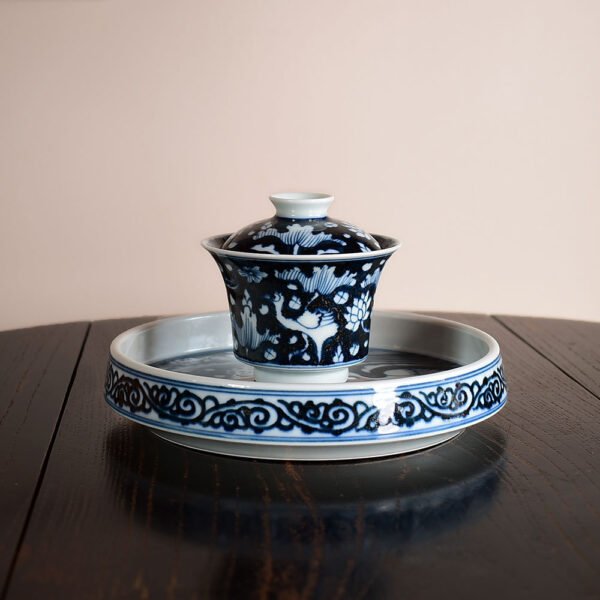
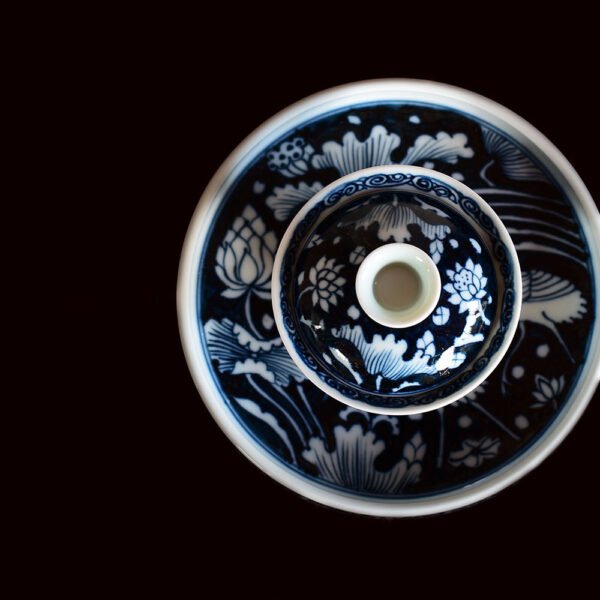
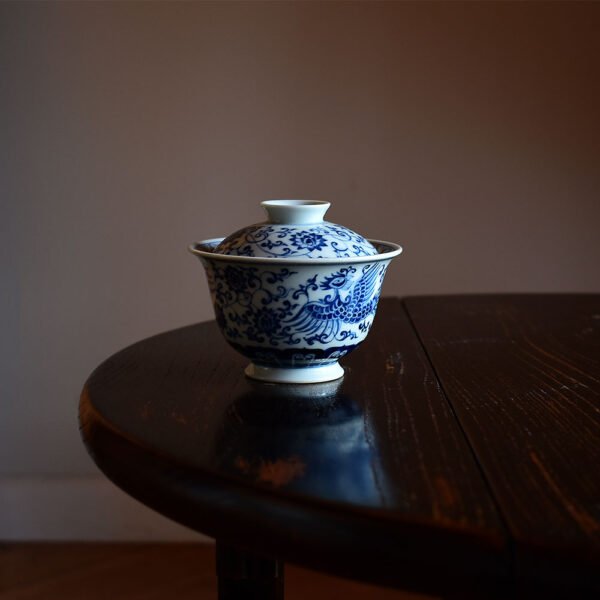
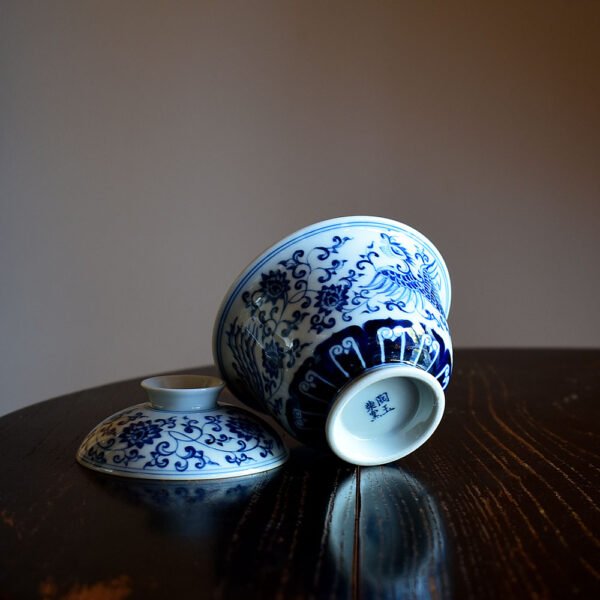
This Yuan-style blue and white fish-and-waterweed gaiwan is crafted using traditional Jingdezhen underglaze blue techniques. The body is sturdy, with a well-balanced form that exudes classical elegance. On the outer surface, vivid hand-painted carp swim gracefully among waving aquatic plants. The composition is lively and natural—the fish scales are delicately rendered, and the water plants sway in dynamic rhythm, revealing the artist’s refined brushwork and artistic finesse.
What sets this piece apart lies within: the interior of the gaiwan features an intricately incised design of fish and weeds, subtly hidden beneath the glaze. As light moves across the surface, the design gradually emerges like a submerged relief, as if the fish are gliding beneath the tea, adding a poetic and graceful charm to the tea experience.
The special pattern of this teacup is fish and seaweed. Since ancient times, fish and seaweed motifs have been traditional decorative patterns in ceramics, representing auspiciousness and carrying rich cultural and aesthetic meanings. The homophonic association between fish and the Chinese word for “surplus” (yu) makes fish a symbol of abundance and wealth. Fish motifs are often used to convey the meaning of “abundance and surplus,” “prosperity year after year” (as the pronunciation of fish is similar to that of “surplus” in Chinese), and “auspicious celebrations and abundance.” The fish and seaweed motifs typically feature fish as the central element, with additional decorations such as water plants, forming a variety of decorative patterns. The depiction of four swimming fish in the artwork symbolizes the concept of “surplus in all four seasons,” representing a year-round surplus, which carries a highly positive connotation. Such motifs are not only favoured by the royal court but also beloved by people from all walks of life as auspicious decorations. The flexible composition, auspicious symbolism, and abundant variations of fish and seaweed motifs have made them timeless classics throughout different eras.
For Yuan blue and white porcelain refers to the blue and white porcelain produced during the Yuan dynasty (1271-1368) in China. The Yuan dynasty was an important period in the history of Chinese porcelain and one of the peaks of Chinese porcelain art. As one of the representatives of that era, Yuan blue and white porcelain exhibited unique artistic styles and technical levels. The characteristic of Yuan blue and white is the use of cobalt blue pigment for painting, which is made of cobalt oxide. After firing, the colour is bright and rich, with extremely high decorative effect. Yuan blue and white porcelain has various shapes, thick and heavy, concise, and fluent lines, and stable and solemn shapes, all made exquisitely.
The evolution of Yuan blue and white is based on the foundation of Tang and Song celadon. Firstly, the glaze colour was improved and innovated. Unique white glaze, eggshell glaze and blue-white glaze were invented to make the glaze crystal clear. Cobalt pigment was imported for glaze colouring. Or using the pigment made from domestic materials.
The formation of tin spots on Yuan blue and white is due to the high content of iron elements in local parts of the blue pigment. After reaching saturation in the high-temperature glaze solution and cooling down, the iron elements in the supersaturated part start to precipitate. If the iron content of the blue pigment is higher and the cooling rate is appropriate, tin spots are more likely to appear on the surface of the ware.
In addition to firing and materials, the formation of tin spots also involves the factor of glaze material. During the painting process, tin spots can also be formed due to the accumulation of blue pigment. Tin spots are more likely to appear on the surface of the ware at the intersections and the starting and ending points of brushstrokes. The formation of tin spots can be said to be a natural creation or an artificial decoration.
This gaiwan has a thick body and uses the Su Ma Li Qing glaze material (a kind of blue pigment), with a heavy sense of tin spots, revealing a unique charm of the past era. The entire production process is completed by hand, and every detail has been carefully designed and polished, giving this teacup a unique artistic charm. The blue and white fish & seaweed pattern is vivid, showcasing ancient cultural and aesthetic values, allowing people to immerse themselves in a beautiful artistic atmosphere while enjoying their tea.

Reviews
There are no reviews yet.